
Outsourcing vs Hiring an In-House Real Estate Photo Editor
Real Estate Photo Editing Outsourcing vs In-House? How you choose?
Friday afternoon looks productive. Three photographers have returned from their shoots. Now, hundreds of property photos are waiting for post-production.
The clients expect polished images quickly. Your editor is already working through yesterday’s queue. Then another photographer calls. They have another listing ready.
This is where a growing photography business faces an important decision. Should you hire another editor? Should you outsource the workload? Or should AI handle most of it?
In 2026, that decision has become more complicated. However, it has also become more interesting. The question is no longer simply about hiring versus outsourcing. It is about designing an editing workflow that can keep up with your business.
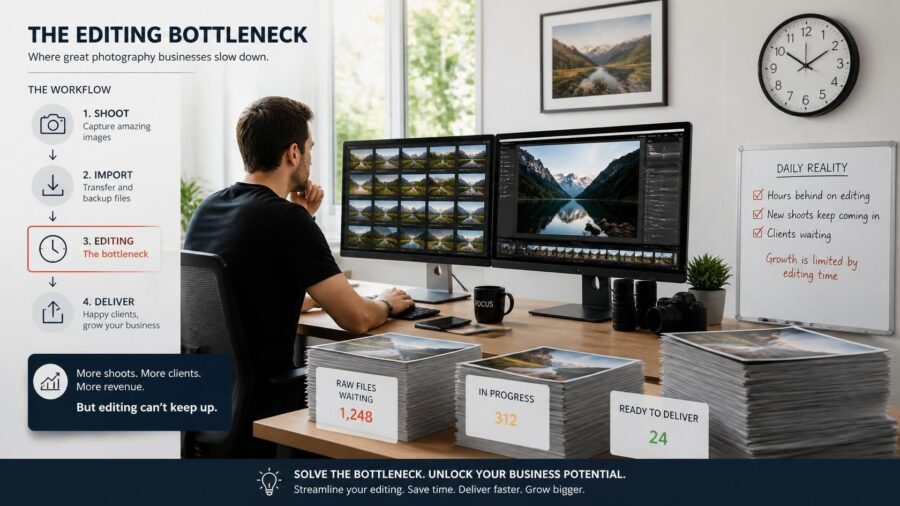
The Editing Queue Can Become Your Real Bottleneck
Photographers often think capacity means the number of properties they can shoot. That is only part of the equation. Post-production can quietly become the limiting factor. Consider a photographer handling five listings every week. Each listing produces dozens of images. Even simple corrections can consume significant time across an entire week. That time comes directly from the photographer’s available schedule.
Consequently, editing can affect how many new jobs the business accepts. It can also affect delivery promises. More importantly, it can affect the photographer’s energy.
A business owner may spend evenings editing instead of developing new client relationships. That creates an opportunity cost that rarely appears on an invoice.
Recent industry discussions show this pressure becoming increasingly visible as photographers look for faster workflows. So, the first question should be surprisingly simple:
Is editing still helping your business, or is it starting to control your business?
Real Estate Photo Editing Outsourcing: When It Starts Making Sense
An in-house editor sounds straightforward. You hire someone. You train them. You establish your preferred style. Then, editing stays inside the company.
For businesses with consistent volume, this model can work extremely well. The editor gradually learns the photographer’s preferences. They recognize common problems. They understand the desired color balance. They also become familiar with recurring clients. That familiarity can create excellent consistency.
However, there is another side. Your workload probably does not remain identical every week. Some weeks are packed. Other weeks are surprisingly quiet. Your editor still needs to be available during slower periods. You also manage recruitment, training, software, equipment, scheduling, and performance. Therefore, an in-house editor creates capacity.
At the same time, it creates a fixed operational commitment. That commitment can be worthwhile. It simply needs enough consistent work to justify itself.
Then Comes the Week You Suddenly Need Twice the Capacity
Growth creates an interesting problem. Imagine your business normally handles 20 listings weekly. Then, several new photographers join your network. Suddenly, production reaches 40 listings. Your editing requirements have doubled. An in-house team cannot always double overnight.
Recruitment takes time. Training takes time. Quality control takes time. Meanwhile, clients still expect their images.
This is where real estate photo editing outsourcing becomes particularly useful.
An external editing team can provide additional production capacity without adding permanent employees.
That makes outsourcing less about reducing costs. Instead, it becomes a capacity-management strategy. You can increase production when demand rises. You can also reduce external volume during quieter periods. That flexibility is valuable for businesses with seasonal or unpredictable workloads.
But Outsourcing Does Not Automatically Solve Everything
This is where many comparisons become too simplistic. Outsourcing is not automatically better. The wrong provider can create more work. You may receive inconsistent colors. You may need repeated revisions. You may spend additional time explaining preferences. Delivery delays can also create problems with your clients. Therefore, outsourcing only works when the workflow is properly designed.
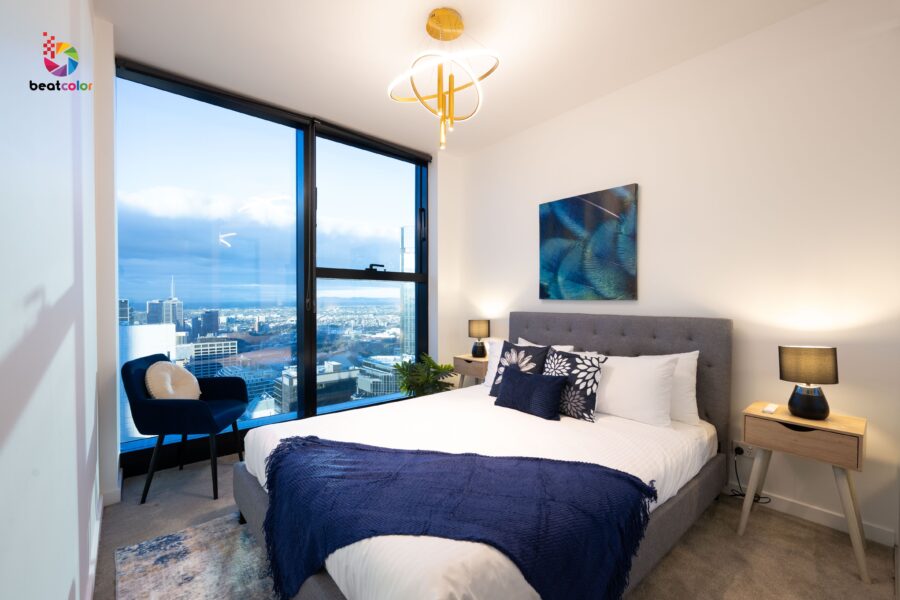
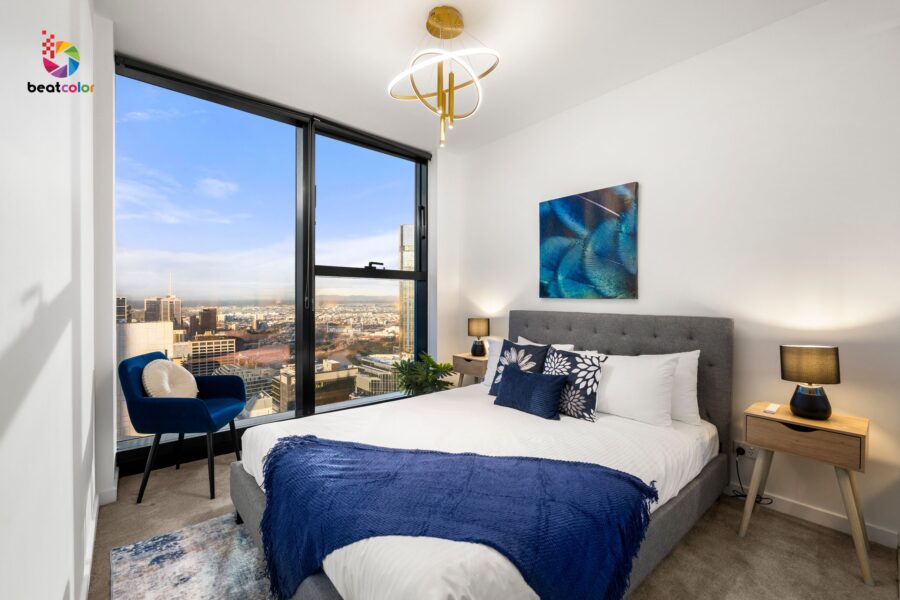
A good provider should understand your visual standards. They should also follow clear instructions. Reference images can make this process much easier. For example, you can provide preferred examples for brightness, window views, colors, and perspective. Over time, these references become a shared editing language. That can make external production feel much closer to an internal team.
The AI Question Changes the Entire Conversation
There is another player in this decision now. Artificial intelligence. AI-powered editing can already automate many repetitive tasks. These include exposure adjustments, color correction, sky replacement, and object removal. Industry sources are also highlighting AI-assisted workflows as a major 2026 trend. That changes the traditional comparison.
Previously, businesses mainly considered two options. They could edit internally or outsource. Now, they have a third option. They can automate part of the process. However, AI does not eliminate every production problem. Real estate photography still requires visual judgment. An edit can be technically impressive while looking unrealistic. That matters because listing photos represent an actual property. Over-editing can create expectations that the property cannot meet. Therefore, speed should not become the only performance metric.
The More Interesting Model Is Probably Hybrid
This is where the 2026 workflow becomes different. Instead of choosing one solution, businesses can combine several. AI can handle repetitive adjustments. Professional editors can handle more complicated images.
An internal team can manage creative direction and quality standards. This creates a workflow with different levels of responsibility. For example, routine images could move through automated processing first. Images requiring additional attention could then enter human review. Complex requests could go directly to experienced editors. This approach can preserve speed without treating every photograph identically.
Several current industry discussions describe this combination of automation and human quality control.
That may become increasingly important as AI capabilities continue developing.
Three Businesses, Three Different Answers
There is no universal winner. Consider three hypothetical businesses.
The Solo Photographer
A solo photographer shoots several properties each week. They spend evenings editing. Their biggest problem is lost time. For this business, outsourcing may create the biggest immediate benefit.
The photographer can use freed-up hours for shooting and client communication.
The Established Photography Company
A larger company has steady monthly volume. It already has documented editing standards. It also has enough work to keep an editor consistently busy. Here, an in-house editor could make financial and operational sense. The company gains direct control over production.
The Growing Multi-Photographer Business
Now consider a business expanding quickly. Its workload changes every month. Some weeks require enormous editing capacity. Other weeks are relatively quiet. A hybrid model may be more practical.
The internal team can maintain standards. AI can handle repetitive work. An outsourcing partner can absorb unexpected volume.
This model creates flexibility without relying entirely on one system.
The Calculation Most Businesses Forget
Before making a decision, calculate the value of your editing hours. Start with your average monthly editing hours. Then calculate the cost of those hours. However, do not stop there.
Ask what else you could accomplish during that time. Could you photograph another property? Could you contact prospective clients? Could you improve your website? Could you build relationships with real estate agencies? Could you simply finish work earlier?
These activities have business value.
Therefore, editing should be evaluated against your opportunity cost, not just your hourly wage. That changes the calculation significantly.
What Should You Actually Choose: Real Estate Photo Editing Outsourcing or In-House?
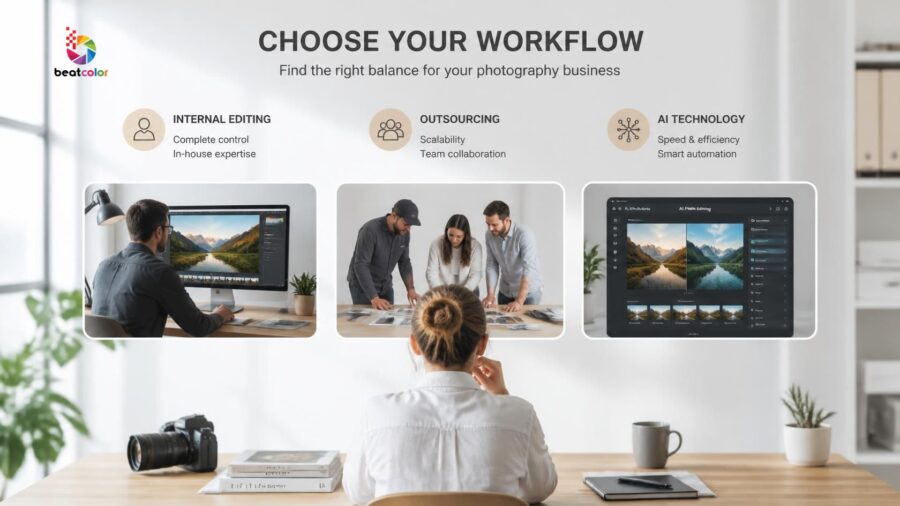
There is no universal answer. Instead, look at your current workflow. If editing volume is low, internal editing may remain practical. When volume is growing quickly, outsourcing can provide valuable flexibility. While repetitive editing dominates your workload, AI can reduce manual processing.
If quality requirements remain high, human review becomes increasingly important. For many businesses, the strongest answer may involve all three. The goal is not to eliminate people. The goal is to eliminate unnecessary friction.
Choose the Workflow, Not the Editor
The old question was simple. “Should I hire an editor or outsource editing?”
In 2026, that question feels incomplete. A better question is: “What combination of people, technology, and external capacity gives my business the strongest workflow?”
That shift matters. Real estate photography is becoming faster, more automated, and more demanding. Meanwhile, buyers continue to encounter properties through digital listing experiences. Professional visual presentation therefore remains an important part of marketing.
The businesses that adapt will not necessarily be those using the most advanced technology. They will be the businesses using technology intelligently. Real estate photo editing outsourcing can provide flexibility. In-house editing can provide control. AI can provide speed. A hybrid workflow can combine their strengths.
Ultimately, the smartest choice is the one that keeps your editing process from becoming your business’s bottleneck.
Read more:
Virtual Staging Services: Complete Buyer Guide
Real Estate Marketing Trends Every Realtor Should Know in 2026
How Realtors Use Virtual Staging to Attract More Buyers