
Why AI-Edited Real Estate Photos Sometimes Look Fake
A buyer books a viewing based on a bright, flawless listing photo and then walks into a dim room with mismatched paint and a stain nobody mentioned. That gap between photo and reality is becoming a familiar complaint, and it usually traces back to one thing: AI-edited real estate photos that look fake.
AI tools have made photo editing faster and cheaper than ever, but speed comes with a trade-off. Automated color boosts, sky replacements, and virtual staging can slip into uncanny territory fast, and once a buyer notices, trust in the entire listing erodes. This article breaks down exactly why AI-edited real estate photos look fake, what causes it technically, and how agents and photographers can keep images polished without crossing into “obviously fake” territory.
What Makes an AI-Edited Photo Look Fake?
Before fixing the problem, it helps to recognize it. A handful of visual cues give away an over-processed image almost instantly, and buyers pick up on them even without knowing the technical cause.
Over-Saturated Colors
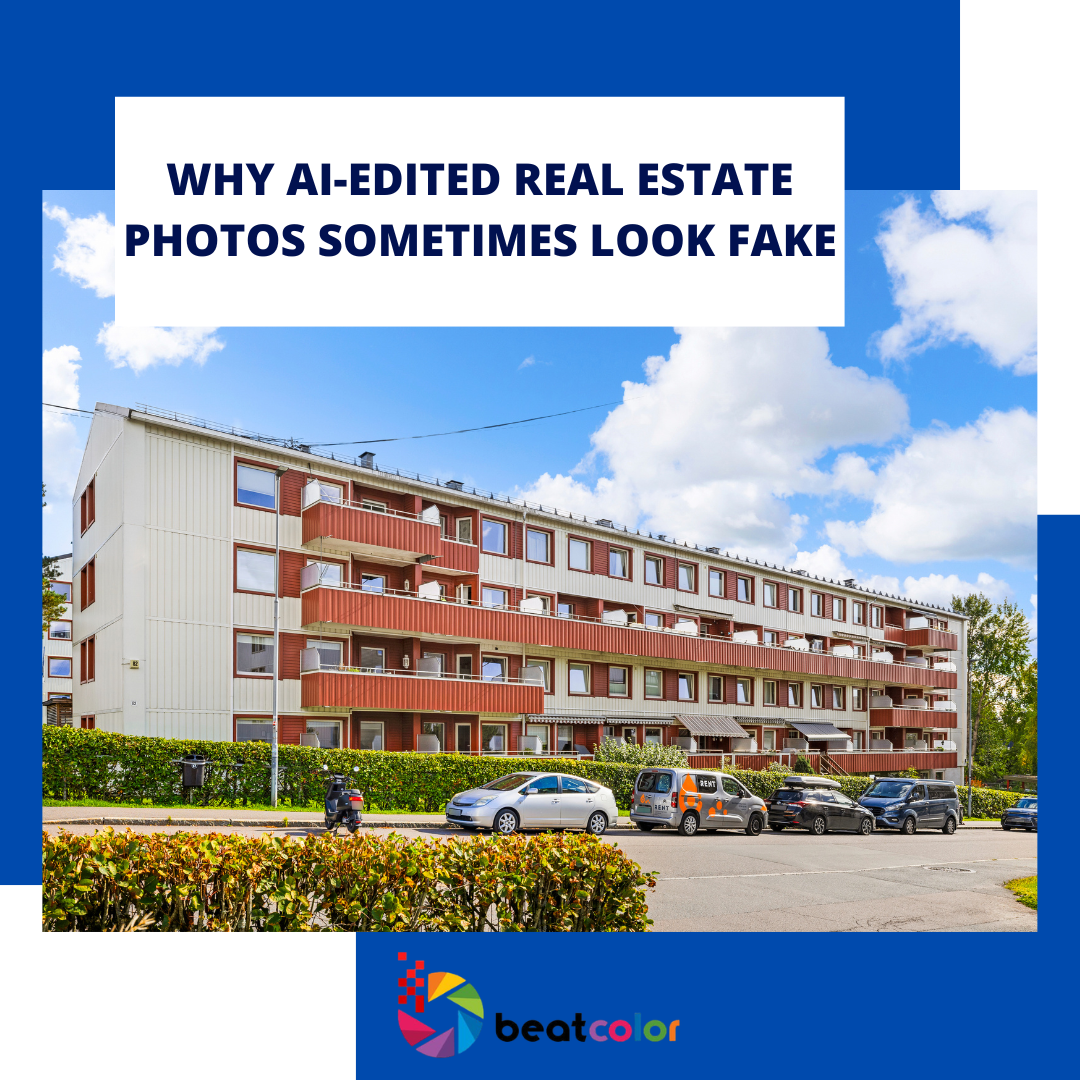
Grass that glows like AstroTurf and skies that look painted rather than photographed are the most common giveaway. AI color-grading tools often push saturation and contrast further than a real scene would ever look, chasing a “wow” effect instead of accuracy.
Inconsistent Lighting and Shadows
Real light behaves predictably: shadows fall in one direction, and reflections match their source. When an AI tool relights a room or swaps a sky, it sometimes forgets to adjust the shadows to match, leaving a photo that feels subtly wrong even to someone who can’t say exactly why.
Artifacts From Object Removal
Removing a car, a trash bin, or a stray cable sounds simple, but AI models frequently leave behind blurred edges, warped lines, or floating objects where the original item used to sit. These artifacts are small, yet they’re often the first thing a trained eye or a zoomed-in buyer notices.
Flat, Textureless Virtual Staging
Virtual staging can furnish an empty room in seconds, but many AI-generated pieces lack the texture, fabric detail, and shadow depth of real furniture. The result reads as a rendering rather than a lived-in space, which undercuts the realism the photo should convey.
Distorted Perspective
When AI tries to widen a room or straighten converging lines, it can stretch walls, warp doorframes, or misalign furniture proportions. Buyers may not name the issue, but something about the room will feel “off” the moment they compare it to reality.
The Technical Reasons AI-Edited Real Estate Photos Look Fake
These visual problems aren’t random. They stem from how developers build and train AI editing models, and understanding the cause makes it easier to avoid the effect.
Most AI editing tools learn from large, generalized datasets rather than from the specific lighting, materials, and layout of the property in front of the camera. Consequently, the model applies patterns it picked up from thousands of other homes instead of responding to the unique conditions of this one room. That mismatch is exactly why a “perfect” AI edit can still feel disconnected from the actual space.
On top of that, fully automated pipelines skip a step that human editors rarely skip: judgment. An algorithm doesn’t know that this particular ceiling light was warm-toned in real life or that this backyard genuinely doesn’t get direct sun until 4 p.m. Instead, it applies a preset correction uniformly, which works fine in some photos and looks jarring in others.
Finally, aggressive upscaling and compression compound the issue. When AI enlarges a low-resolution photo or blends multiple exposures, it can introduce a smooth, slightly plastic texture across surfaces. Skin, wood grain, and fabric lose their natural imperfections, and the photo starts to look synthetic even if no single edit was extreme.
Why This Matters for Agents and Sellers
An unnatural photo isn’t just a cosmetic issue, it has real consequences for the people relying on it to sell a home.
First, mismatched expectations damage trust the moment a buyer walks through the door. If the listing photo oversold the space, the buyer’s first reaction is skepticism, and that skepticism tends to carry through the rest of the viewing. Second, heavily altered photos raise genuine legal and ethical questions. Regulators and MLS boards increasingly scrutinize edits that misrepresent a property’s actual condition, and what looks like harmless enhancement can cross into misrepresentation if a permanent fixture appears to change. Third, and often overlooked, an agent’s personal brand takes the hit. Buyers remember which agent’s listings “looked better in photos than in person,” and that reputation follows them into future deals.
AI-Edited Real Estate Photos Done Right: Balancing Speed and Realism
None of this means agents should abandon AI editing, it means the process needs a second layer of judgment. The difference between a fake-looking photo and a great one usually comes down to whether a human reviews the AI’s output before it goes live.
Fully automated, “one-click” AI editing prioritizes speed and consistency across hundreds of photos at once. AI-assisted editing, on the other hand, uses the same technology to handle the repetitive heavy lifting of noise reduction, basic color correction, and object detection while a trained editor fine-tunes the result against what the room actually looked like. That combination keeps turnaround times fast without sacrificing accuracy.
A few principles separate natural results from obviously fake ones: colors should match what a person would see standing in the room, shadows and light sources should stay physically consistent, and no edit should add or remove structural elements the property doesn’t actually have. When editors hold AI to that standard, it becomes a tool for clarity rather than exaggeration.
How to Choose a Photo Editing Service That Uses AI Responsibly
Not every editing service applies the same level of care, so it’s worth vetting a provider before handing over an entire portfolio of listings. A few questions reveal a lot: Does the service use AI only to assist a human editor, or does every photo ship straight from the algorithm with no manual review? Can they show real before-and-after examples from occupied, real-world properties rather than staged demo photos? And do they offer a “true-to-life” guarantee, or does the language suggest edits stay within what a buyer would reasonably see in person?
At BeatColor, AI only speeds up repetitive tasks like noise reduction, initial color balancing, and basic object detection and never makes final creative decisions. A professional editor then finishes and quality-checks every photo, comparing it against the real property before delivery. The goal isn’t to make a home look like something it isn’t, it’s to present the property at its best while keeping every detail buyers can verify in person. That’s the difference between a photo that generates showings and one that generates complaints.
Final Thoughts
AI has genuinely changed what’s possible in real estate photography, cutting editing time from hours to minutes. But when automation runs unchecked, it produces oversaturated skies, warped rooms, and plastic-looking staging that make buyers distrust a listing on sight. The fix isn’t avoiding AI, it’s pairing it with experienced human editing that keeps every photo grounded in reality.
If you want listing photos that look polished without looking fake, BeatColor built its AI-assisted, human-reviewed editing process for exactly that balance.