

Common Virtual Staging Mistakes and How to Avoid Them

Virtual Staging Mistakes can quickly turn attractive listings into missed opportunities. Although AI now stages empty rooms within seconds, creating believable results remains surprisingly difficult. Buyers may not recognize every editing flaw, but they immediately notice when an image feels unrealistic.
According to the National Association of Realtors, nearly every homebuyer starts the search online. As a result, listing photos often determine whether buyers keep exploring or move to another property. Virtual staging should help buyers imagine living in the space, not distract them with artificial furniture, awkward layouts, or inconsistent lighting.
As AI-generated staging becomes increasingly common, realism matters more than ever. This guide highlights the most common virtual staging mistakes and explains practical ways to avoid them while creating natural, trustworthy listing images.
Why Buyer Trust Starts With Realistic Images
Homebuyers make decisions quickly. Research across digital marketing consistently shows that first impressions happen within seconds.
Real estate works exactly the same way. Before reading property details, buyers evaluate the photographs.
Every image silently answers an important question.
“Can I trust this listing?”
When virtual staging feels realistic, buyers continue exploring. When editing appears artificial, trust begins to fade.
Interestingly, obvious mistakes are not always the biggest problem. Small inconsistencies usually create stronger negative reactions.
For example, oversized furniture subtly changes room proportions. Unnatural shadows confuse the eye.
Impossible reflections make images feel computer-generated. Most buyers never recognize these technical errors.
Instead, they experience uncertainty without knowing why. That uncertainty often reduces engagement.
Consequently, fewer buyers request tours or contact agents. Realistic staging creates the opposite effect.
It removes distractions.
It encourages emotional connection. Most importantly, it allows buyers to focus on the property’s potential instead of questioning the editing.
Mistake One: Designing for Trends Instead of Target Buyers
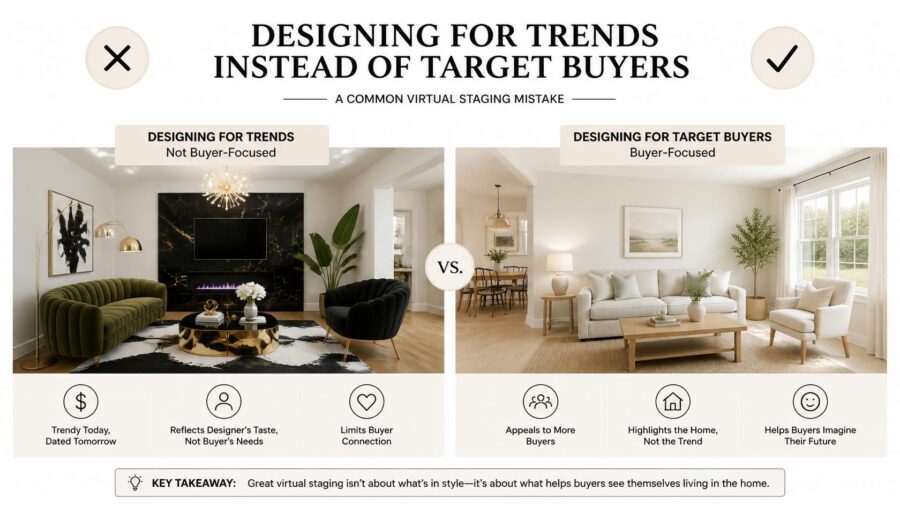
Beautiful interiors do not always sell homes. Successful virtual staging begins with understanding who will likely purchase the property. Unfortunately, many listings prioritize fashionable furniture over buyer expectations.
This mistake has become increasingly common because AI tools frequently generate trendy interiors automatically. Although those designs look attractive, they may not match the property’s market.
Imagine a suburban family home furnished like a luxury downtown penthouse. The styling appears sophisticated.
Nevertheless, it feels disconnected from the neighborhood. Families searching for functional living spaces may struggle to imagine everyday life there.
Likewise, minimalist furniture may undersell a luxury residence requiring warmth and character.
Effective virtual staging tells the property’s story. Every furniture choice should reinforce that story naturally.
Before selecting a design style, consider several practical questions. Who will probably buy this home? What lifestyle does the neighborhood support? Which interior style feels authentic rather than fashionable?
Answering those questions creates staging that resonates emotionally instead of merely looking impressive.
Professional editors rarely chase design trends alone. Instead, they balance current aesthetics with buyer expectations. That balance produces images remaining relevant long after temporary design fashions disappear.
Mistake Two: Allowing AI to Make Every Creative Decision
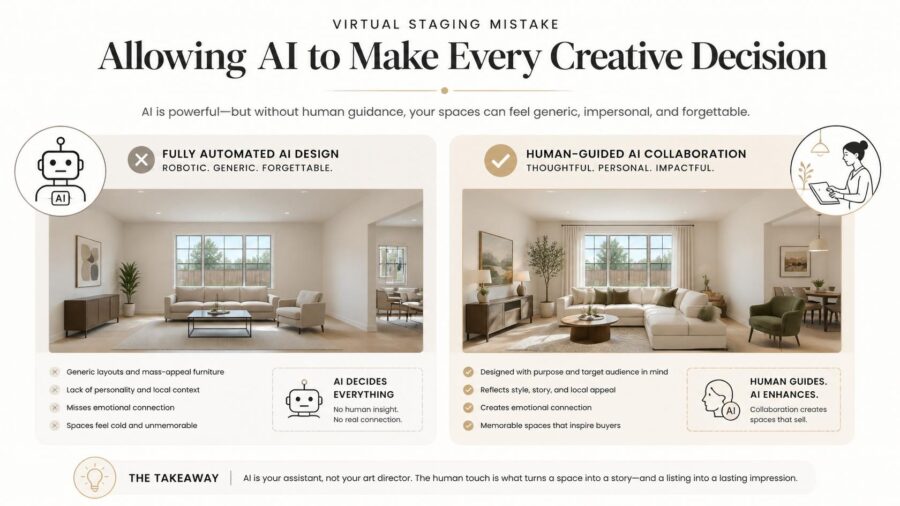
Artificial intelligence has become an excellent production assistant. However, it should never become the final decision-maker.
Many automated staging platforms prioritize speed above accuracy. As a result, unrealistic details frequently appear throughout finished images.
A dining chair may partially block a doorway. A sofa might float slightly above the floor. Coffee tables occasionally appear too small for surrounding furniture.
Sometimes windows cast shadows from impossible directions. Individually, these flaws seem minor.
Collectively, they weaken credibility. Experienced editors recognize something important. Virtual staging is not simply furniture placement. It is visual storytelling.
Every object should respect perspective, architecture, lighting, and room functionality.
AI still struggles with that complete understanding. The strongest workflow today combines artificial intelligence with human expertise.
Technology accelerates repetitive tasks. Professional editors refine every important detail before delivery. That partnership creates images that feel polished without appearing artificial.
Mistake Three: Filling Every Corner With Furniture
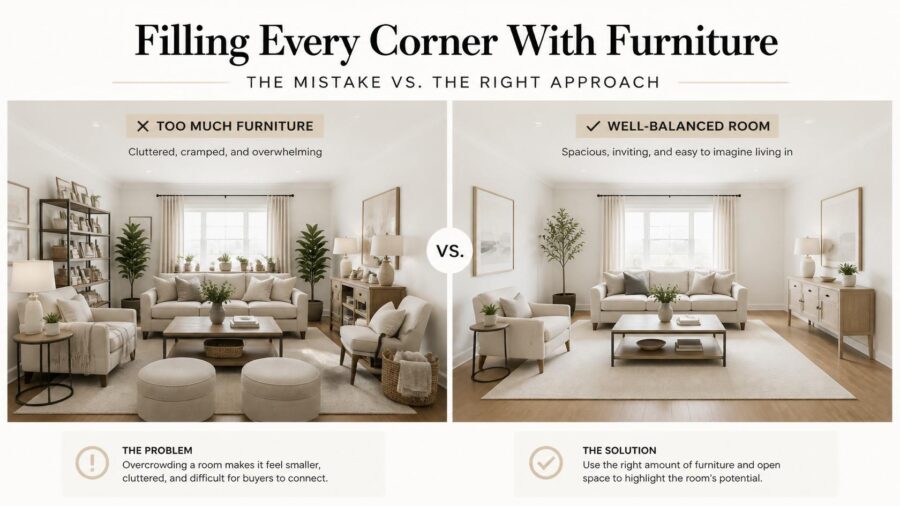
Many empty rooms need furniture. However, they do not need every available decoration.
Overstaging remains one of the most common virtual staging mistakes today.
Editors sometimes add large sofas, oversized artwork, multiple tables, and excessive accessories. The room may appear luxurious.
Unfortunately, it also feels smaller. Buyers want to understand the available space.
Too much furniture hides important architectural features. Large windows become less noticeable.
Fireplaces lose attention. Beautiful flooring disappears beneath oversized rugs.
Instead, every piece should serve a purpose. A thoughtfully staged room feels open and comfortable.
It also allows buyers to imagine adding their own belongings. Minimalism does not mean empty. It means intentional.
Professional editors often remove unnecessary items before delivering the final image. Sometimes, less truly creates more impact.
Mistake Four: Ignoring Natural Light and Shadows
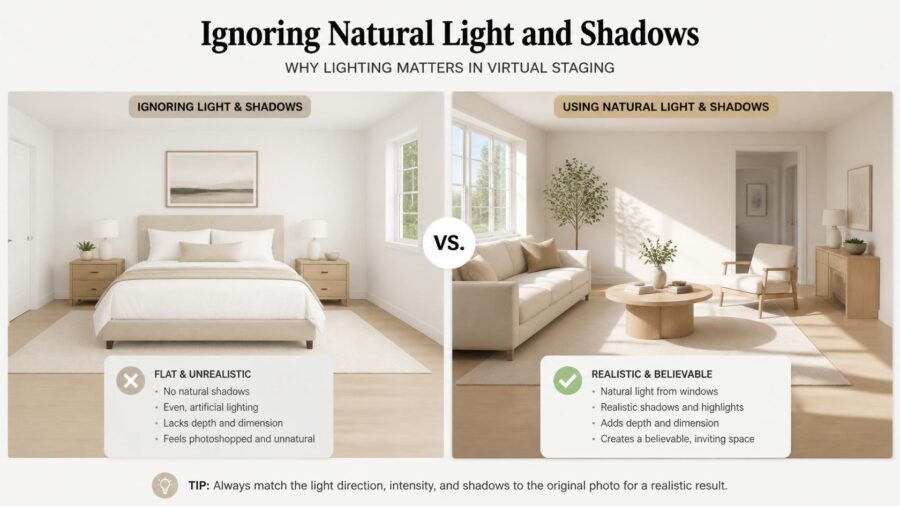
Lighting can make or break a staged image. Surprisingly, buyers notice lighting errors almost instantly.
Natural light should remain consistent throughout the room. If sunlight enters from the left, furniture shadows should follow the same direction.
Likewise, artificial lighting should complement the property’s existing fixtures. Many AI-generated images still struggle with realistic lighting.
A bright room may suddenly contain dark furniture shadows. Window reflections may not match the outdoor environment.
These inconsistencies seem small. However, they quickly reduce authenticity.
Professional editors spend significant time balancing exposure, contrast, and shadow placement. Their goal is simple.
Everything should appear as though it was photographed naturally. When lighting looks believable, buyers stop analyzing the image.
Instead, they begin imagining themselves inside the home. That emotional shift makes every listing stronger.
Mistake Five: Forgetting Architectural Consistency

Every home has its own personality. Virtual staging should respect it.
Unfortunately, some staged interiors ignore the property’s architecture completely. Imagine placing ultra-modern furniture inside a century-old farmhouse.
Now imagine filling a sleek penthouse with heavy rustic décor. Neither approach feels convincing.
The furniture may look beautiful on its own. However, it creates visual conflict. Successful virtual staging complements existing features.
Wood flooring, ceiling beams, fireplaces, and window styles should guide every design decision. Editors should also consider regional preferences.
A beach property often benefits from light, relaxed interiors. A luxury city apartment usually calls for cleaner, contemporary styling.
Matching the home’s architecture creates harmony. Harmony builds confidence.
Confidence encourages buyers to continue exploring the listing.
Mistake Six: Prioritizing Speed Over Quality Control
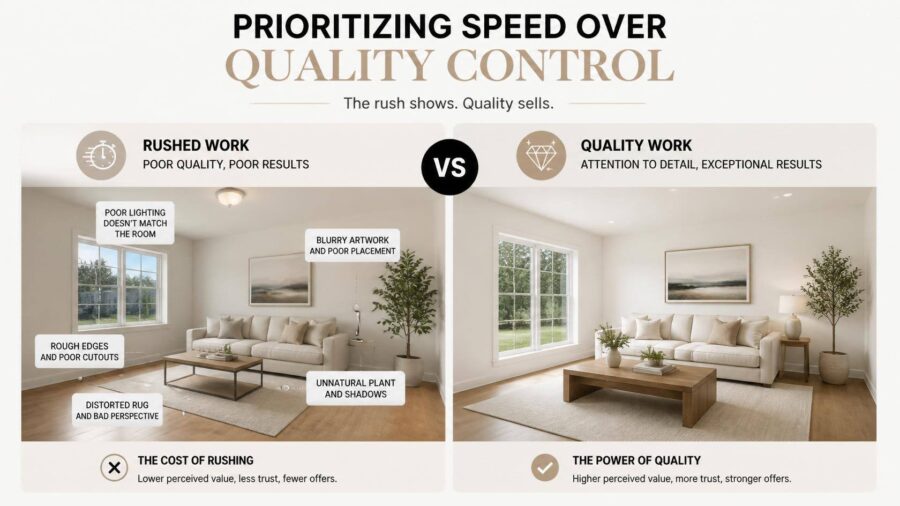
Fast delivery sounds attractive. However, rushed editing often creates avoidable mistakes.
Many companies now promise virtual staging within minutes. While impressive, automated speed should never replace careful review.
Professional quality control remains essential. Editors should inspect every image before delivery.
They verify furniture scale, check masking accuracy and confirm perspective alignment.
This review process may take only a few minutes. Nevertheless, those minutes often determine whether buyers trust the listing.
Quality assurance is not an extra service. It should be part of every professional workflow.
The best virtual staging companies understand this principle. They combine efficient technology with experienced human reviewers.
That combination consistently produces stronger marketing images.
Mistake Seven: Treating Virtual Staging as Decoration Instead of Marketing

Many people believe virtual staging simply makes rooms prettier. Actually, its purpose goes much deeper.
Virtual staging is a marketing strategy. Every design decision should help buyers imagine living inside the property.
Beautiful furniture alone cannot accomplish that goal. Instead, each room should communicate function.
A spare bedroom could become a comfortable home office. A finished basement might become an entertainment space.
An empty corner could suggest a quiet reading area. These subtle choices help buyers visualize possibilities.
Furthermore, staged rooms should highlight lifestyle rather than luxury alone. Today’s buyers appreciate practical living.
They want flexible spaces. They value comfort as much as appearance. Virtual staging succeeds when buyers stop noticing the furniture. Instead, they begin imagining their own lives inside the home. That emotional connection often drives inquiries more effectively than expensive décor.
A Professional Checklist Before Publishing Virtual Staged Images
Before uploading listing photos, ask these important questions.
- Does every furniture piece fit the room naturally?
- Are lighting and shadows consistent?
- Does the design match the home’s architecture?
- Is every doorway completely accessible?
- Do reflections look realistic?
- Are room proportions preserved?
- Does the space feel inviting without appearing overcrowded?
- Would buyers believe this room exists exactly as shown?
If the answer is “no” to any question, additional editing may be worthwhile. Small improvements often create significant differences.
Virtual Staging in 2026: AI Changes the Workflow, Not the Standard
Artificial intelligence continues transforming real estate marketing. Virtual staging software becomes faster every year.
New tools generate impressive room designs within seconds. However, buyers have also become more selective.
They scroll through hundreds of listings every week. As a result, unrealistic images stand out immediately.
The industry’s competitive advantage is no longer speed alone. It is credibility.
Leading real estate professionals increasingly adopt hybrid workflows. AI generates initial concepts.
Experienced editors refine every important detail. This approach delivers efficiency without sacrificing quality.
Technology should support creativity. It should never replace professional judgment.
Ultimately, successful virtual staging still depends on understanding buyers. That principle remains unchanged despite rapid technological advances.
Final Thoughts
Virtual staging continues to evolve alongside artificial intelligence. Yet one truth remains constant.
Buyers respond to authenticity. The most effective staged images never look staged.
They feel natural, balanced, and believable. Avoiding common virtual staging mistakes requires more than advanced software.
It requires thoughtful design, careful quality control, and an understanding of buyer psychology. When those elements work together, virtual staging becomes far more than digital decoration.
It becomes a powerful sales tool. Instead of simply filling empty rooms, it tells a compelling story.
That story helps buyers picture their future home. In today’s competitive market, that emotional connection can make all the difference.
Read more:
Can AI Real Estate Photo Editing Replace Professional Editors?
Complete Real Estate Image Enhancement Guide
Virtual Staging Services: The Complete Guide for Realtors