
Why Professional Real Estate Editing Still Matters in the AI Era
Artificial intelligence has changed almost every corner of real estate marketing. With one click, agents can sharpen a dull photo. They can brighten a dark room. They can even generate virtual staging in seconds. It’s no surprise that many professionals are asking a simple question. Do we still need professional real estate editing? Or can AI tools handle everything on their own?
The short answer is yes. Professional real estate editing still matters. In many ways, it matters more than ever. AI has made editing faster and more accessible. But it hasn’t replaced the judgment, consistency, and market understanding that trained editors bring. In this article, we’ll explore why human expertise remains essential, even as automation reshapes the industry.
The Rise of AI in Real Estate Photography
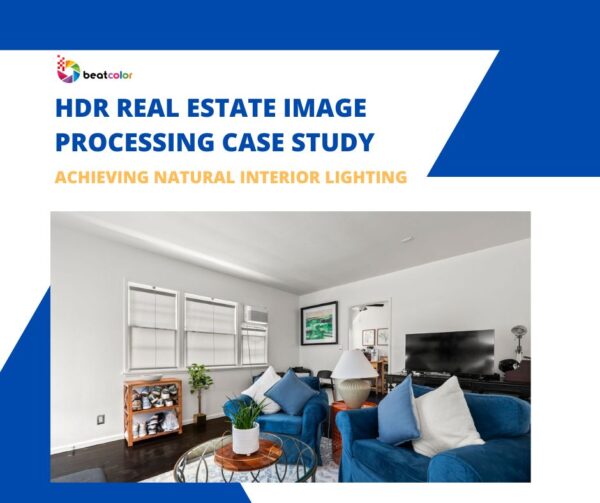
AI-powered editing tools have exploded in popularity over the past few years. Automatic sky replacement, one-click HDR blending, and instant object removal are now standard features. So is AI virtual staging. For busy agents managing dozens of listings, these tools promise speed and convenience.
There’s no denying the value of automation for basic tasks. AI can save time on repetitive corrections, like exposure balancing or noise reduction. But speed is not the same as quality. Convenience doesn’t guarantee a polished, market-ready result. This is where the limitations of fully automated editing start to show.
Where AI Editing Falls Short
1. Lack of Context and Judgment
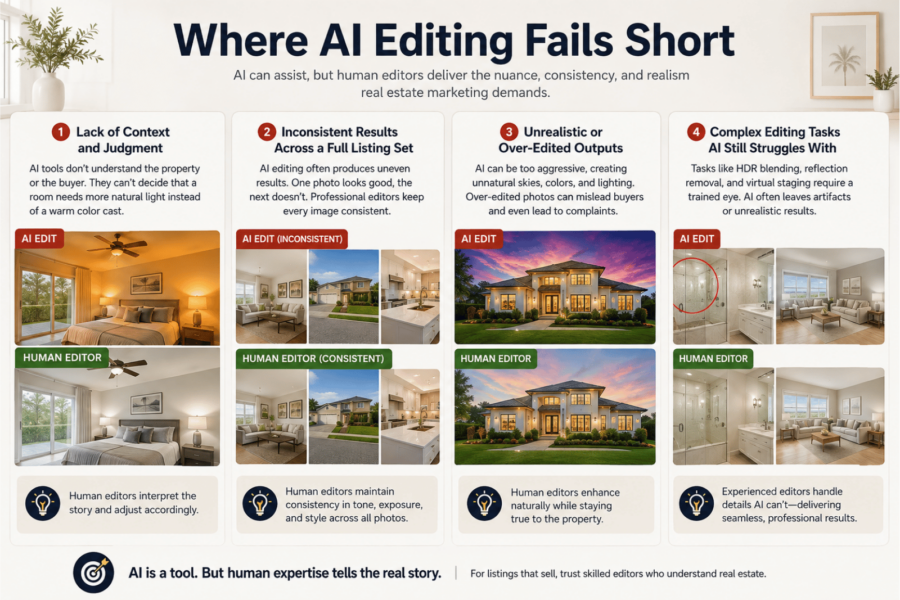
AI tools process images based on patterns, not context. They don’t know when a listing targets luxury buyers versus first-time homeowners. They can’t tell that a room needs natural light instead of a warm color correction. Professional real estate editing relies on human judgment to interpret a property’s story. Editors adjust each image accordingly. Algorithms simply can’t replicate that kind of consistency.
2. Inconsistent Results Across a Full Listing Set
A typical listing includes 20 to 40 photos. These cover interiors, exteriors, aerial shots, and twilight images. AI editing often produces uneven results. One photo might look perfectly balanced. The next might have an unnatural color cast or an over-processed sky. A professional editor keeps every image in the set consistent. Tone, exposure, and style stay unified, creating one cohesive visual story buyers can trust.
3. Unrealistic or Over-Edited Outputs
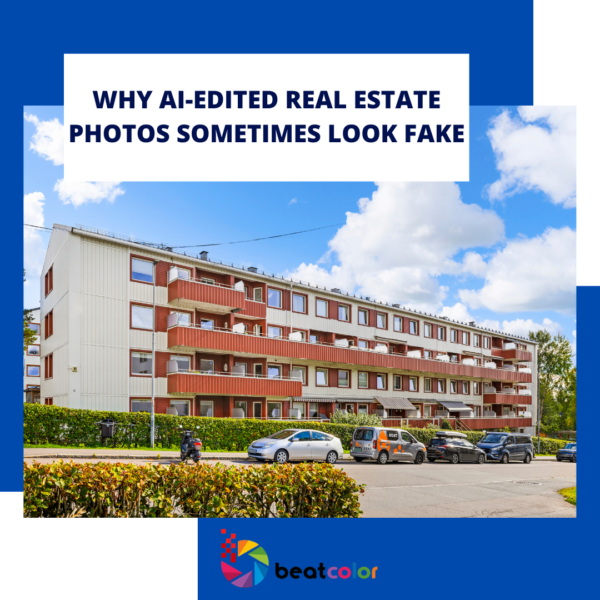
AI enhancement tools can be overly aggressive. They may brighten rooms beyond realistic levels. Sometimes they create skies that look artificial. This is a serious risk in real estate marketing, where accuracy matters both ethically and legally. Buyers who feel misled by over-edited photos are more likely to walk away from a showing. Some may even file a complaint. Skilled editors know how to enhance a photo while keeping it true to life.
4. Complex Editing Tasks AI Still Struggles With
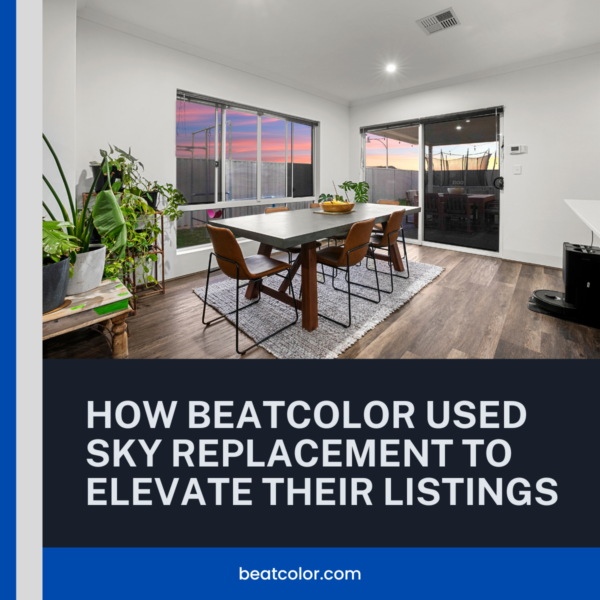
Some tasks still require a trained eye. Twilight conversion is one example. HDR bracket blending is another. Removing items near reflective surfaces, like mirrors, glass, or water, is especially tricky. Virtual staging that matches real lighting and perspective is hard to automate well. AI often introduces visible artifacts or unnatural blending in these scenarios. Experienced editors, on the other hand, can achieve seamless, photorealistic results.
What Professional Real Estate Editing Brings to the Table


Trained Eye for Composition and Detail
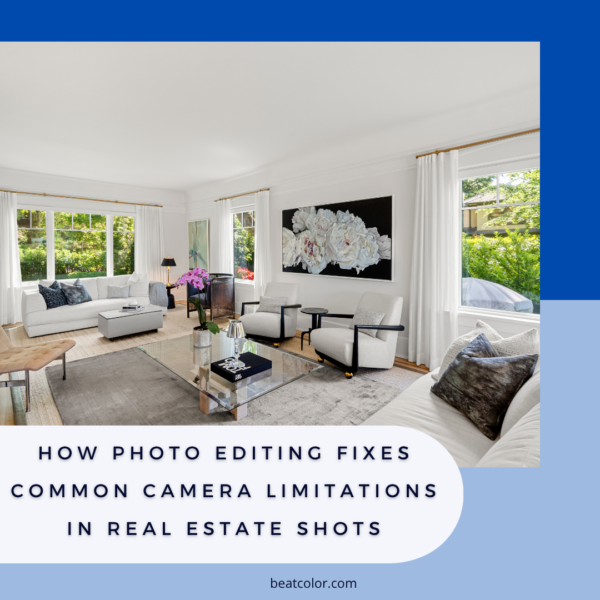
Professional editors notice small details that AI often misses. A crooked horizon is one example. Distracting clutter is another. So are mismatched color temperatures between rooms and reflections that reveal editing artifacts. This attention to detail elevates listing photos from “good enough” to genuinely compelling.
Brand and Market Consistency
Real estate photography isn’t just about individual images. It’s about building a consistent visual brand for an agent or agency. Professional editing services apply the same style guidelines across every listing. This helps agents build recognizable, trustworthy branding over time. Generic AI filters simply can’t customize at that scale.
Faster Turnaround Without Sacrificing Quality
Many people assume professional editing means slower turnaround. But that’s often not true. Reputable professional real estate editing services combine skilled editors with efficient workflows. They also use select AI tools to speed things up. Many can deliver high-quality results within 24 to 48 hours. This hybrid approach captures the best of both worlds: speed from technology and precision from human expertise.
Customization for Every Property Type
Not every property should be edited the same way. Luxury estates often call for dramatic, moody twilight shots. Family homes usually benefit from bright, warm, and inviting tones. Professional editors tailor their approach to each property type and target buyer. AI’s one-size-fits-all filters simply can’t do that.
The Best Approach: AI as a Tool, Not a Replacement
The most effective real estate marketing strategies don’t choose between AI and human editors. They combine both. AI handles repetitive, high-volume tasks, like initial color correction or batch resizing. This frees up professional editors to focus on what really matters: composition, realism, and emotional appeal.
This hybrid workflow is quickly becoming the industry standard. Agencies that rely solely on AI risk producing inconsistent, sometimes unrealistic images. That can hurt buyer trust. Agencies that combine AI efficiency with professional oversight, however, consistently produce listings that stand out in a crowded market.
Why This Matters for Agents and Agencies

Listing photos are often a buyer’s first impression of a property. In a competitive market, that first impression matters a lot. Poorly edited or inconsistent images can cause buyers to scroll past a listing. This happens no matter how great the property actually is.
Investing in professional real estate editing isn’t just about aesthetics. It’s a business decision. It directly affects how quickly a property attracts interest. It also shapes how credible an agent appears to potential clients. High-quality, consistent visuals build trust. They generate more inquiries. Ultimately, they support faster sales at better prices.
Final Thoughts
AI has undeniably transformed real estate photo editing. It has made certain tasks faster and more accessible than ever. But speed and automation are not substitutes for expertise, consistency, and creative judgment. Professional real estate editing still plays a critical role. It produces listing photos that are realistic, polished, and tailored to the property and its target buyers.
The industry keeps evolving, but one thing stays clear. The winning strategy isn’t choosing AI over human editors. It’s using AI as a powerful tool within a professional editing workflow. For agents and agencies who want to stand out, investing in professional real estate editing remains one of the smartest decisions they can make today.
Read more:
Case Study: Day-to-Dusk Editing That Increased Listing Engagement
Edited Photos Help Realtors Sell Homes Faster — Here’s How
Real Estate Editing Partner: How to Choose the Right One